The 4 Best Camping Stoves of 2025
Top pick
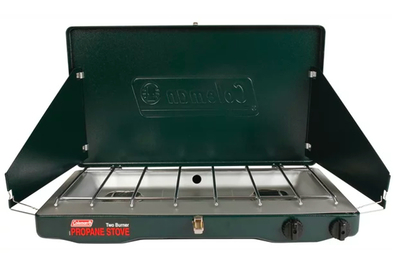
This straightforward, rugged two-burner stove cooks food quickly and evenly. And it’s less than half the price of other stoves we tested.
The Coleman Classic Propane Camping Stove’s most important feature is its reliability—despite getting tossed in and out of our cars repeatedly, it continued to work perfectly.
We also appreciated its versatility. This Coleman model boiled water faster than any other stove we tested under $150, yet when we turned it down low, it was gentle enough to griddle golden-brown pancakes.
On a single, 16-ounce tank of propane, this stove can cook with both burners on high for roughly an hour, and it has the barest minimum of parts, so it’s easy to maintain.
This Coleman model does not have a piezo igniter (the little red button on a lot of stoves—including our runner-up and upgrade picks—that lights the gas), so you’ll need to bring a lighter. To us, that’s just one fewer thing to break (and if you’re paying less than $150 for a stove, the piezo igniters almost always break).
Runner-up
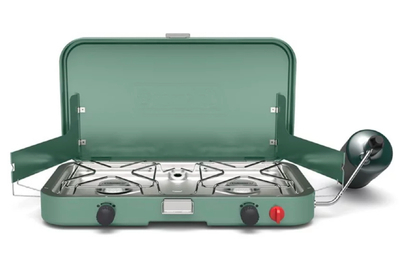
The Cascade is similar to the Classic stove, but it allows you to adjust cooking temperatures with more precision, and it includes a handle for easier carrying. However, it’s more expensive.
If our top pick is out of stock, or you’d like more cooking control (and a stove with potentially a touch more durability), the Coleman Cascade 222 2-Burner Camping Stove represents the next step up from the Coleman Classic.
What separates it from the Classic (and adds to the price tag) is more control throughout the range of cooking temperatures. It boils water a bit faster than the Classic, yet it still has a gentle flame that lets you cook food more delicately than on the Classic (for instance, if you prefer your eggs soft scrambled).
It also includes a piezo ignition, which is fine as long as you don’t expect that component to last forever (none of them do). The Cascade case is easier to carry, thanks to its included handle.
Upgrade pick
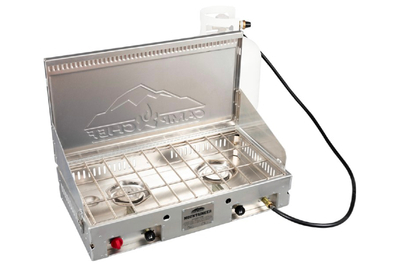
Due to its solid construction, this two-burner stove is heavier to carry than the Coleman models, and it’s more expensive. But the Mountaineer also has a more-powerful output, so you can cook on it like it’s your home stove.
The heavy-gauge, all-aluminum Camp Chef Mountaineer Aluminum Stove is built like the tough, classic camping equipment you hear salty old-timers or vintage-equipment nerds talk about. It’s more expensive than either of our Coleman picks, but if you’re comfortable with the jump in cost, the Mountaineer may be worth the investment.
Weighing just over 16 pounds, this stove is 4 pounds heavier than the Coleman Classic. But with its large, three-way windscreen, a hookup for a big (5 to 20 pounds) propane bottle, and a 40,000 Btu output (double that of the Coleman Classic), the Mountaineer lets you do more in the way of high-heat cooking than our other picks. For instance, you can sear a steak at a higher heat than on our other picks and get a darker char more quickly, so you can cook more food in the same amount of time.
Managing the controls does require finesse—with a stove this powerful, it’s easier to burn your food than to keep the heat low. This stove is great for very committed car-camping gourmets, but for most campers, the cost and durability are overkill.
Best for…
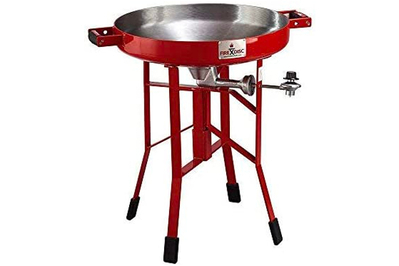
If you often cook for a crowd, the FireDisc’s paella-pan-like design is ideal for making big meals. This stove is great for those who don’t want to tote extra cookware.
You probably won’t be hauling the Original FireDisc 380 Portable Propane Cooker too far from your car (in total this stove weighs 55 pounds, so it’s the heaviest model we tested). Yet this stove break downs into three fairly easy-to-carry components: two supporting trusses and one large pan.
It has the simplicity and strength of something you’d expect to last a lifetime (with the proper care). In other words, the FireDisc 380 should last a lot longer than its five-year limited warranty. It has a single-pan design (think of a wok or a paella pan, though the FireDisc stove is most closely related to a Mexican discada), so you can do away with the usual pots, pans, and sear plates.
Cooking on the FireDisc 380 is akin to using a large griddle plate: You can make a single large-pot meal, like a stew or fry-up, or set up zones for different foods, as you might when preparing fajitas. Either way, to some extent you’re inevitably cooking everything together, and the heat controls are limited.