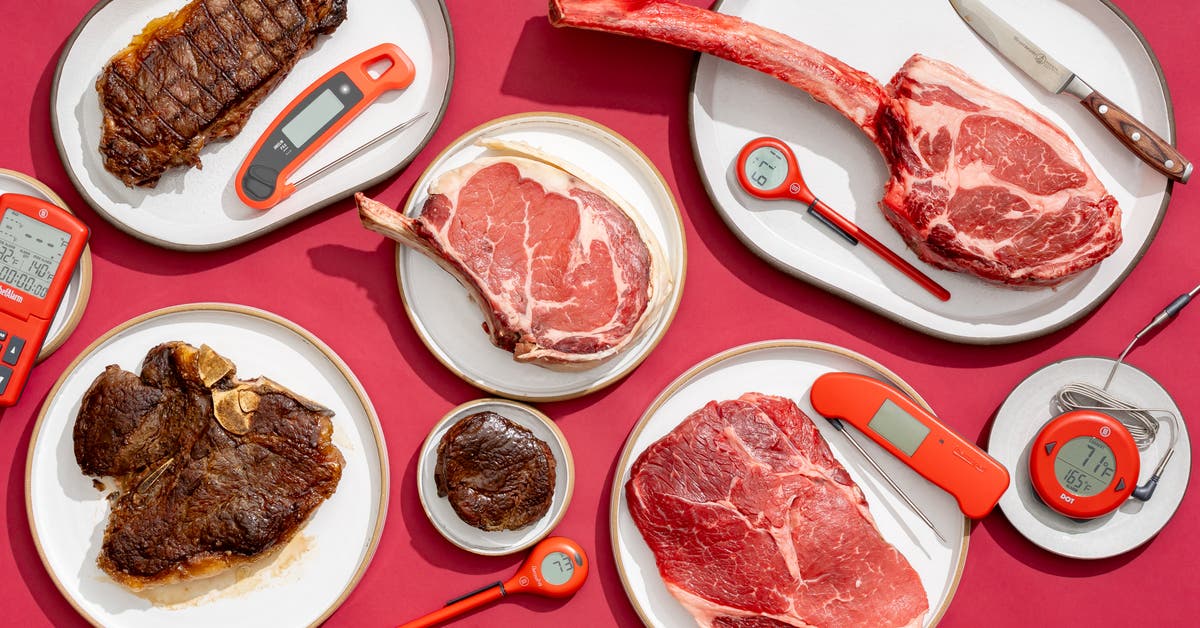
The 6 Best Meat Thermometers for 2025
Instant-read thermometers
The Lavatools Javelin was previously our runner-up pick. After some consideration, though, we concluded that it didn’t hold a candle to its newer sibling, the Javelin Pro Duo, or to the ThermoWorks ThermoPop 2. The Javelin has a notably shorter probe, and its display does not rotate or light up.
The OXO Good Grips Thermocouple Thermometer did very well in our tests, reading temperatures in about 2 seconds. It has a nice, illuminated screen, but its probe is shorter than those on our other instant-read picks. The OXO is pricey, and we think the Javelin Pro Duo or ThermoPop are better value.
The factory-calibrated, Thermapen-like Maverick PT-100 was glacial when testing ice water (taking nearly 11 seconds), and it read lower than all of the other thermometers in our sous vide test.
Taylor’s 9867 Digital Folding Probe Thermometer has a bright display and a thin probe tip, at 1.5 millimeters. But its digital screen doesn’t rotate, and reviews cite durability issues.
The CDN TCT572-W ProAccurate Folding Thermocouple Thermometer, a Thermapen-style model, was pretty fast during our first chicken-broiling test, but it was still half a second behind the Thermapen. In a second test, the CDN finished behind all of our picks.
If you like a stick-style thermometer, our prior runner-up, the Polder Stable-Read, is a bit cheaper than the ThermoPop 2. But we preferred theThermoPop 2’s display. Plus, it’s faster and sturdier.
The CDN DTQ450X ProAccurate Thermometer, our original pick for the best instant-read thermometer, remains an accurate thermometer with a wide range. It has one of the thinnest probes, at 1.5 millimeters, as well as a calibration option and a number of handy temperature-holding and alert functions — all for a relatively low price. But newer thermometers in a reasonably close price range do the job much faster.
The CDN DTW450L ProAccurate Waterproof Thermometer had a little over a 6-second response time; this was 2 seconds slower than it took our slowest instant-read pick. And we feared its long, 8-inch probe would snap.
The Taylor 9842 Commercial Waterproof Digital Thermometer has a good range (-40 °F to 450 °F), essentially mediocre speed ratings (and it’s notably slower on ice water), and a calibration screw.
The AcuRite 00665E Digital Instant Read Thermometer is an inexpensive thermometer in the fold-out style of the Thermapen. It felt cheap during use — the buttons seemed to require mashing, and the probe was not particularly thin. And to get hot or cold temperatures, this thermometer always took at least 10 seconds, sometimes up to 19 seconds.
Basic probe thermometers
The Lavatools Element was very slow at reading temperatures, taking up to 15 seconds in some instances. The temperature readings increased sporadically, making it difficult to anticipate the temperature changes. Its digital controls aren’t as intuitive to use as those of our picks, and the buttons are difficult to press.
We found the receiver of the dual probe ThermoPro TP20 hard to read because it alternated the display of both probe temperatures, which we found confusing. The membrane-sealed push button on the receiver also became worn after only a few uses.
Since the ThermoPro TP16 is so light and the cable is so stiff, the unit moved around the counter when we opened and closed the oven door. We also found that the thermometer’s stand positioned the digital screen at an awkward angle for reading.
Although the Taylor 1478-21 Digital Cooking Thermometer has intuitive buttons and a simple design, it’s slow at reading temperatures. And it can’t work on a hot grill because the cable and probe are heat-resistant to only 392 °F.
Probe thermometers with wireless capability
The ThermoWorks Signals 4-Channel BBQ Alarm Thermometer comes with four probes (one is an air probe for measuring the ambient temperature of the oven, grill, or smoker), and you can use them all simultaneously. It can also connect to an app on your phone via Bluetooth or Wi-Fi. But this pricey thermometer is overkill unless you regularly cook several cuts of meat at a time.
The ThermoWorks BlueDot is the same as the ThermoWorks Dot we recommend, except it can connect to an app on your phone via Bluetooth. But for the price, you’ll get more distance, features, and durability from the TempSpike Plus’s single probe version. Or you can save money and stick with the Dot.
The ThermoWorks Smoke has a backlit screen and volume control, and it can operate via a wireless receiver with two channels to accommodate multiple probes: one probe to take the internal temperature of the meat and an air probe for measuring ambient temperature. But considering its price, we think the TempSpike Plus is a better value.
The Weber iGrill 2 was very slow to read temperatures and had the shortest probes of all the models we tested. We found that it began to lose its wireless connection at around 125 feet.
Designed specifically for the Weber Genesis II and Genesis II LX gas grills, the Weber iGrill 3 lacks a digital display on the unit, so you can only view the thermometer’s temperature readings via an app on your phone.
The MeatStickX’s setup was arduous and enervating. In our boiling-water test, it wouldn’t rise above 198 °F, yet it sent several alerts that the probe was overheating. It also failed the ice-water test.
The ChefsTemp ProTemp 2 Plus’s setup was glitchy, and the thermometer would not rise above 203 °F during the boiling-water test. The charging block is also big and clunky, and it’s not as sleekly designed as others in this category.
The Meater SE would not go above 200 °F in the boiling-water test. We had better beef results with the Meater Pro Duo, and we liked how the app allowed for resting time. But our chicken ended up vastly undercooked.
The Fireboard Pulse would not rise above 195 °F in the boiling-water test. It was also slow to read in the ice-water and sous-vide tests, and we found the summary charts hard to read.
We ended up with an overcooked roast beef, thanks to the RFX by Thermoworks. It also would not rise over 205 °F in the boiling-water test. We had similar results with the ThermoPro Twin TempSpike.
Chef IQ’s IQ Sense oddly left us with an overcooked roast beef but a slightly undercooked chicken. It also tended to disconnect at short distances.
The instructions for the Inkbird Bluetooth Meat Thermometer warn not to use it in boiling water, so we skipped the boiling-water test for this model. It was slow to read in other tests and left us with an undercooked chicken. Its app had connectivity issues, dropping intermittently even when placed near the oven. And among the probes of all the models we tested, this one’s probe left the largest holes in the meat.
Although there was a lot to like about the Combustion Inc. and Typhur Sync models, their readings were just too inconsistent across all tests for us to recommend them.
This article was edited by Marilyn Ong, Gabriella Gershenson, and Marguerite Preston. Kevin Purdy contributed reporting.