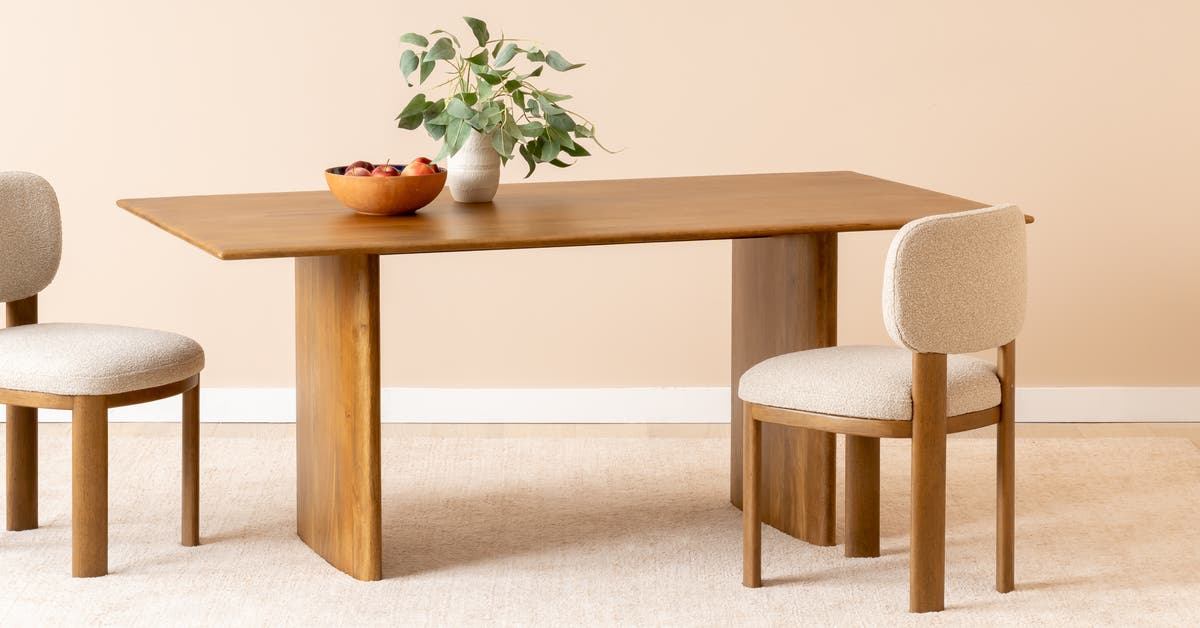
The 7 Best Dining Tables of 2025
To decide which dining tables to test, I started by surveying the current low- and midpriced dining-table landscape across styles, retailers, and materials, both online and in stores. I evaluated dozens of retailers, including Amazon, Anthropologie, IKEA, Article, Castlery, West Elm, Room & Board, CB2, World Market, Soho Home, DWR, Wayfair, and Pottery Barn, among others. I pored over the specs and rounded up a list of contenders that met the following criteria:
- promising materials and craftsmanship for the price
- hundreds of customer reviews and a rating of four or more out of five stars
- a reasonable return policy and warranty
- a style that would stand the test of time
With about two-dozen models in mind, I narrowed down the list to tables that were well reviewed and representative of key styles and price points. And then we tested eight tables at Wirecutter’s office in Long Island City, New York. Three other tables were tested at my home. For each table, I did the following:
I checked for stability. Putting each table’s joinery through a stress test, I leaned on every model from multiple angles. And I did an array of pulling, pushing, knocking, and dragging tests, in order to determine wobbliness and how substantial each table felt.
I gauged real-life seating capacity and legroom. Using a standard 18-inch-high chair and placemats, I sat at each table to see how many adults it could comfortably fit. I ran my fingertips wherever the average diner might interact with a table — along the tabletop, legs, and apron (a wood or metal piece under the tabletop) — to assess how these areas felt.
With help from staffers and paid testers, I compared each table’s stated seating capacity to what it actually felt like to sit at with the specified number of people. And I considered how users of different heights, ages, and abilities would interact with the table.
In addition to aprons, I checked for support bars, crossbeams, and any bracing that might interfere with the chairs and legs of those dining.
I evaluated the materials and finishes. Generally speaking, hardwoods like walnut and oak age well, while veneer (a thin layer of wood that’s applied to another material to mimic solid wood) doesn’t tend to last as long. But hardwood can be cost-prohibitive for some, and there’s a wide range of durability among veneer tables.
Just because a table is listed as being “solid wood,” that doesn’t necessarily indicate a level of craftsmanship. “Higher-end tables are built out of premium grade lumber — think clear material, no knots — and the boards are wider,” according to Marina Kotchoubey, owner of heirloom-quality woodworking studio Ian Ingersoll, in West Cornwall, Connecticut. A cheap solid-wood table may be made from many small boards, while a higher-end tabletop may be crafted from just four to six. With all of that in mind:
- For the wood models, I counted how many boards appeared in each tabletop. And I compared each piece against its photos to see whether the finish looked the same in person. I also looked for consistent grain matching, balanced proportions, and inconspicuous hardware. I confirmed that the surface was finished with a protective top coat.
- For those tables with veneer, I also evaluated the tabletop’s grain pattern (higher-end tabletops often look like a single, seamless board of wood, whereas cheaper ones may have many boards). And I gauged whether the overall effect felt like real wood or more plasticky.
- For glass-top tables, I checked that they were tempered.
- For marble-top tables, I confirmed with the company that they were sealed.
I checked that tables were easy to maintain. I placed a glass of ice water directly on each tabletop to see whether condensation left rings or shadows, impacted the veneer, or wiped clean. I also lightly dragged a key across a section of the surface to see if it would leave marks. I wiped and blotted off everyday messes (like fingerprints, coffee spills, and breadcrumbs) in order to see how well the surfaces responded to cleaning.
I recorded how long it took to assemble any tables that required assembly (and how many people were needed). I also noted how clear the instructions were and examined the quality of the assembly hardware. Ultimately, I favored tables that came with white-glove delivery (it’s often included in the shipping cost) or those that could be assembled by one or two people.