Board Gaming Console: It Has the Tech but Needs More Games
Based on my encounter with the Board, I’ve been thinking of the games as belonging in three basic categories: games that best take advantage of the Board’s unique form and interaction mode, games that use the tech well but aren’t particularly deep games, and games that don’t really make good use of the pieces.
Well-integrated games: None of these are groundbreaking games per se, but the best of them show off the potential of the interaction and input methods that the Board offers. The best are fun to play precisely because they use the pieces thoughtfully, creating an experience that isn’t quite like playing a video game or quite like playing a board game.
The abstract strategy game Strata, for instance, features six Tetris-like shapes that players place on the board in an attempt to claim territory. In addition to trying to arrange the shapes on the 2D plane of the game board, players must keep in mind that some squares require blocks to cover their space one or two levels above the board, which the game can track by observing the orientation of the different shapes. It also allows players to bridge pieces over blocked spaces and be creative in how they manipulate the physical pieces.
It’s a simple concept, but trying to implement it in a tabletop game would be extremely difficult, and manipulating digital objects on a screen where the pieces just snap to the grid of the board would be less satisfying as a game experience.
There’s also the Overcooked-esque Chop Chop, which tasks players with working together in a busy kitchen to prepare and serve orders as they come in. A number of the tasks (chopping ingredients, stirring soups, cleaning work stations) require the players to use one of the plastic pieces.
Again, on its face, it’s a pretty simple concept, and when implemented digitally via touch controls or a controller, it’s quite straightforward. But when your group is trying to juggle multiple orders that all require the physical pieces, it leads to a bizarre version of Twister as you all try to reach across the table to get your piece to the correct station — or just panic as you lose track of where that dang knife went.
These games (and a Lemmings-like game called Save the Bloogs) give me hope that as Board matures as a platform and more developers get their hands on it, we could get a wave of games that utilize this technology in unique and interesting ways. But as it stands now, the three or four games that do this well are a bit overshadowed by the ones that, well, don’t.
Cool but shallow games: These games tend to be fairly simple and don’t use the conductive pieces for much more than moving around the screen. They show off the technology well, and they’re a fine on-ramp for learning how the Board works, but after you get the basics down, they’re not particularly engaging to play.
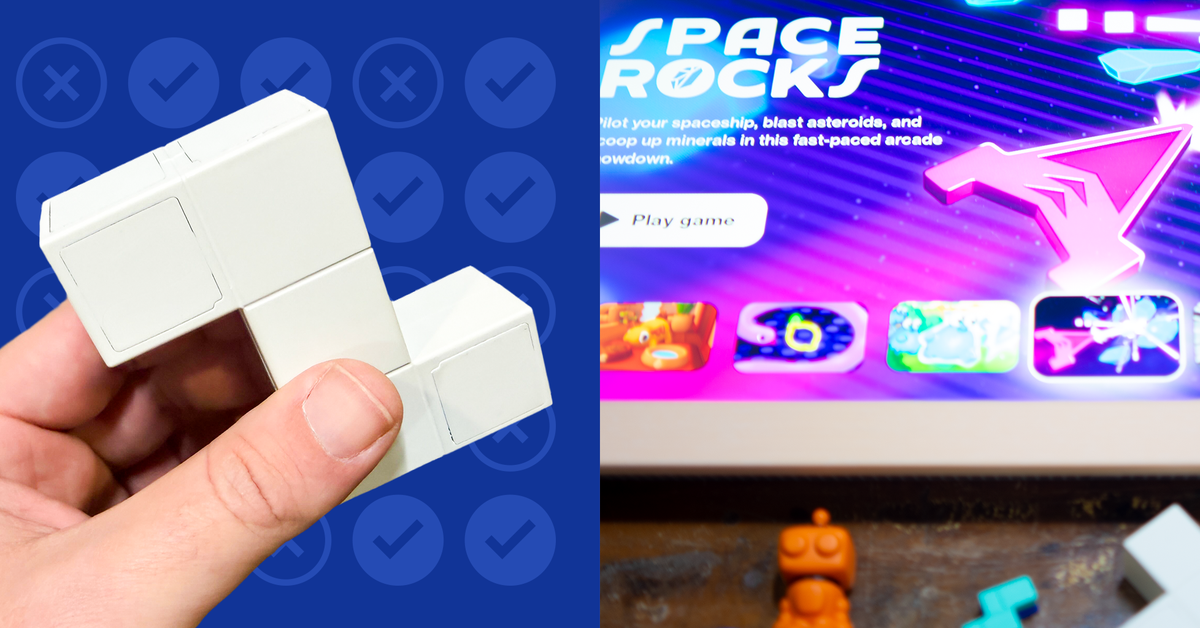
Snek (a version of the classic phone/calculator game Snake), Space Rocks, and Starfire (variations on Asteroids and Pong, respectively) all feel similar. These games aren’t bad; they just don’t have much depth. Mostly they seem like initial concepts intended to prove that the technical idea behind the Board worked. And they do that. But after playing for 30 minutes or so, you probably won’t have a strong desire to revisit them.
Overly basic mobile-style games: A few of the games don’t add anything by integrating the pieces. They feel like games that you’d find in a mobile app, where the pieces are not really used for anything other than selecting a move. This isn’t bad — it just seems like a bit of a waste in this context.
Both Omakase (a two-player game where opponents try to collect sets of sushi by placing a pair of chopsticks) and Cosmic Crush (a Candy Crush–like game about pushing aliens around to form sets of three or more) would have worked equally well with touch controls alone, which makes the pieces a bit redundant.
There’s also one game that represents an outlier fourth type: a Tamagotchi-style experience called Mushka, where players use the pieces to take care of a little dog-like creature. It’s cute in a mini-game kind of way, but like the others in the previous two categories, it isn’t particularly deep or engaging.