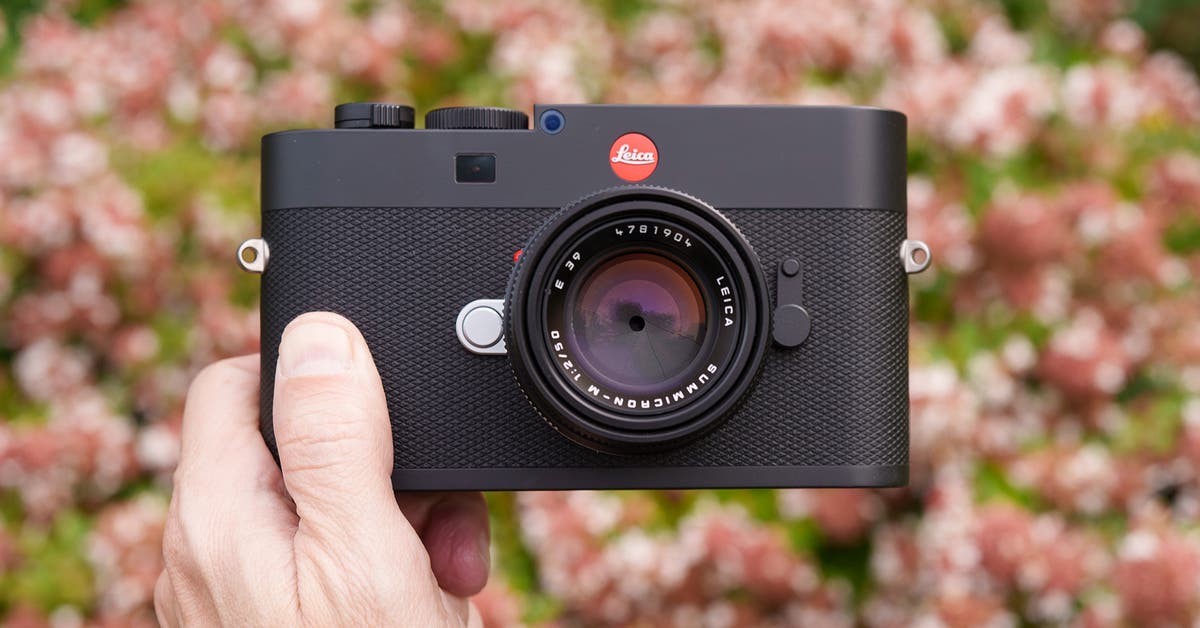
Leica M EV1 Review: Our Expert’s Take on Leica’s New Camera
The EVF changes the way you shoot. The biggest difference that most Leica photographers are likely to notice with this new finder is that what you see is what you get.
This means that you can see exactly how the settings you choose — including JPEG presets — will affect the final image. The EVF also boosts visibility in dim shooting conditions, compared with a rangefinder.
But it also means that you can’t see outside the bounds of the image, as you can with the frame lines in Leica’s M11 rangefinder. In some cases that limitation may make it a little more difficult for you to time your shot if you’re waiting for something to enter the frame.
It can also make the experience feel less interactive and less intellectual. Since you see exactly what the camera will capture, you aren’t forced to think about how the camera settings you choose may hypothetically affect the image; that kind of thinking sometimes leads to a deeper understanding of what those choices mean.
It allows you to use a wider range of lenses without added gear. The M EV1’s EVF opens up the ability for you to use lenses wider than 28mm — the limit of the built-in rangefinder in the M11 — without the need for an accessory finder.
Plus, if you’ve ever shot with a 135mm lens on a Leica M camera, you’ll know just how small the image you’re trying to frame is in an optical rangefinder. The M EV1, in contrast, presents the live view from telephoto lenses at the same size as that from wide-angles.
You rely on new kinds of focus assists, rather than on the traditional rangefinder patch. Manually focusing the M EV1 means either relying on focus peaking, which highlights the edges of anything in the frame that’s in focus, or digitally zooming in to the image. Or both.
Because you can choose to zoom anywhere in the frame, you can frame first and then focus precisely just before snapping your picture. The lever on the front of the camera lets you control the amount of zoom or enable/disable the focus peaking.
I enjoy using manual focus on EVF-equipped mirrorless cameras with all kinds of lenses, including lenses made for the system I’m shooting, as well as older lenses adapted from other systems. In my experience, focusing the M EV1 was on a par with manually focusing on most higher-end mirrorless cameras — it’s a great implementation. I was able to focus precisely, without any serious learning curve.
You can choose the info you see in the finder. All of the usual info you might see in the viewfinder of a mirrorless camera — shutter speed, aperture value, ISO, exposure compensation and meter reading, battery level — can be found at the bottom of the M EV1’s EVF. Rather than being overlaid on the image preview, it appears in its own separate area below the preview.
However, you can choose to put grid lines, a level, or a histogram on the screen if you want them. We were especially happy to see the last feature, since it allows for better exposure decisions.
You can access menus without pulling the camera away from your face. Because the EVF basically acts like a second LCD, you can navigate the menus to quickly change something while you have your shot lined up. This is a feature that’s standard issue on most other cameras but adds a new dimension to shooting with an M-series body.
The battery life is quite bad. One of the big upgrades that the M11 has over the older M10 is longer battery life — more than double, at around 700 shots per charge. Although the M EV1 uses the same battery as the M11, it’s rated for only a meager 237 shots when you’re using the EVF. Shooting from about 7:30 a.m. (starting with the battery at 90%) through 1 p.m. (when the battery hit 10%), I got 293 shots when recording both DNG and JPEG files simultaneously. That’s comparable to what you’d get from a small point-and-shoot like the Ricoh GR IV.
You can charge the battery while it’s in the camera by connecting a wall charger or portable power pack to the USB-C port. I connected my ZMI PowerPack 20K Pro from 1:10 p.m. to 2:55 p.m. and got the battery back up to 95%, which was good enough for the rest of the day’s work. That said, you’re better off getting one or two more batteries, if you can afford it — note that they currently cost nearly $250 each.