The 11 Best Scissors of 2025
A good fabric scissor is designed to deliver precise, clean cuts that don’t fray or damage your fabrics. That means thick, long blades set extremely close together to create tension that helps keep your fabric steady as you cut. The flat bottom blade allows the shears to lay flat against the table as you cut through the fabric.
With that being said, our staff sewists think our overall top-pick scissors, the Fiskars Original Orange-Handled Scissors, are also the best choice for an entry-level fabric scissor.
Note that if you opt to use the original Fiskars scissors for both general cutting and fabrics, you should buy two pairs and label one “for fabric only” so the blades stay crisp and unblemished.
“For a nice intro pair of scissors, I don’t really think you can beat Fiskars,” said updates writer Abigail Bailey, who worked as a sales associate at the cut counter of a fabric and craft store for a year and has been quilting for several years. Abigail saw customers gravitate toward cheaper, generic-brand scissors, but she believes that the original Fiskars scissors are well made and worth the few extra dollars.
Wirecutter’s quilt and textile expert, senior staff writer Jackie Reeve, also relies on Fiskars scissors for her fabric work. She’s had the same pair for nearly 20 years and has kept them in good shape by sharpening them and making sure they’re used carefully.
However, if you’re looking for a nice gift for a sewist, the Gingher Knife Edge Dressmaker’s Shears (8-inch) are made with forged steel and have a flat bottom blade for steady cutting. The rounded handle is comfortable to hold and can be used ambidextrously. Abigail has had a pair of these sturdy shears for three years.

For the sewist looking for a specialty scissor, these forged-steel shears have a flat blade for steady cutting, are comfortable to hold, and come with a lifetime warranty.
“They cut through fabric like butter,” Abigail said of her Gingher scissors. “It is so smooth. It’s like you’re not cutting through anything, it just goes.”
For consistent quilters and other experienced cutting crafters, Jackie recommends a switch to rotary cutters and a self-healing cutting mat. She uses Olfa rotary cutters, which she said is the brand she sees “mentioned the most among quilters.”
Rotary cutters are much faster to use and allow for quick, clean cuts through large pieces of fabric. The blades are sharp and can be changed out, so Jackie extends the life of her blades by using the sharpest, newest blades on her fabric and saving dull blades for cutting out paper patterns.
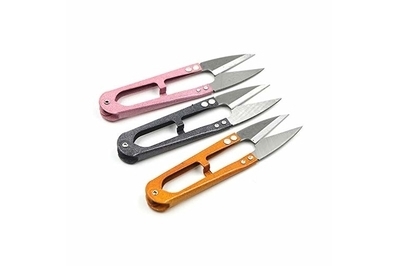
We recommend adding these snips to your crafting essentials kit in our guide to the best fiber craft kits.
Kase Wickman, the author of our fiber craft kits guide, recommends the Deein Sewing Scissors (4.1-inch) as a supplemental item that can improve your crafting experience. They have sharp, pointy blades made with high-carbon steel and an easy-to-hold, squeezable handle. Storing a pair with your craft materials means you don’t have to hunt down your full-size scissors each time you need to snip some thread or yarn—just be careful to store them safely.