The 2 Best Electric Toothbrushes of 2025
Oscillating toothbrushes
The Oral-B Vitality ($20) is the brand’s least-expensive electric toothbrush with a rechargeable battery. Oral-B declined to disclose the number of oscillations, vibrations, brushstrokes, or bristle movements for any of its toothbrushes, but we noticed that the Oral-B Vitality’s movements felt weaker than those of the Oral-B Pro 1000 and Pro 500 ($30). It is equipped with one mode and buzzes after two minutes of brushing but does not offer quadrant pacing. It has the same grippy body as the Pro 500, and like that model and our top pick, it’s compatible with standard Oral-B replacement brush heads and warrantied for two years.
Brushes in the Oral-B iO Series start at about $50 for the iO Series 2 and go up to about $250 for the iO Series 10. The iO Series 6, which has a lighted pressure sensor and a digital display with a countdown clock, currently represents the best value in the line. Unlike other electric toothbrushes in Oral-B’s line, the iO Series models are compatible only with iO-specific replacement brush heads; the most economical offer at this writing is about $8 each in a package of four, but they can cost as much as $15 each. Each iO Series brush has an onboard two-minute timer with quadrant pacing and a varying number of cleaning modes. All iO Series models can connect to the Oral-B app, which tracks your brushing duration; depending on the iO Series model, the app may also track where you’re brushing on an interactive color display of the mouth. The idea behind this feature — and the brush-head position detection on several other smart toothbrushes — is to provide you with an overview of which teeth you’re cleaning well and which teeth you may want to pay more attention to. Brushing with an iO Series brush feels high tech, and the position detection was accurate in our limited test runs.
An Oral-B representative informed us that the company’s Smart and Genius series brushes will eventually be phased out in favor of iO Series models. Brushes in the Oral-B Smart series include the Smart 1500, which does not connect to an app but offers a lighted pressure sensor. The Smart 5000 connects to Oral-B’s app to track how often and how long you brush, as well as whether you tend to press too hard. Oral-B’s Genius series includes the Genius 7000, which has six cleaning modes programmed to a separate power button. The Genius 8000 can track the brush’s position in your mouth, thanks to onboard location sensors and access to your phone’s front-facing camera. The Genius X, like the Genius 8000, can connect to your phone. Rather than using your phone’s front-facing camera, however, the Genius X uses onboard sensors and “artificial intelligence” to track the brush head’s location as you move it around your mouth. We found the tracking spotty, as the app counted some unbrushed teeth as clean.
Few competitors regularly cost less than the Oral-B Vitality. Among them are the Amazon Basics Rechargeable Toothbrush (currently unavailable) and the Bitvae R2. The Amazon Basics brush represents a minimal cost savings over time, and its replacement brush heads are harder to find than Oral-B’s. The Bitvae brush, on the other hand, is especially competitive on price — the brush, plus a two-year supply of replacement brush heads, generally costs around $25 — and has a visible pressure sensor. In our testing we found that the R2, which also has a two-minute timer with quadrant pacing, emitted an irritating, extremely loud noise while in operation, making it hardly usable.
The Quip 360, the brand’s first rechargeable oscillating toothbrush, typically costs $55 if you forgo the optional subscription refill plan (replacement heads cost $11 each, plus shipping, when purchased outside of a subscription). The brush has quadrant pacing and automatically powers down after running for two minutes. It has three intensity options you cycle through with a single button. Unlike our picks, it has a visible pressure sensor. We found the pressure sensor effective, but somewhat hard to see when brushing bottom teeth (the light shines on only one side of the brush handle). When you bite down on the brush head, the 360 temporarily powers down until you let up on the pressure. In our testing, the 360’s battery lasted 32 days of twice-daily brushing on a single charge — two days longer than advertised. It runs at about 40 decibels, making it louder than our picks, but not terribly so. The handle’s rounded bottom is a flaw (possibly, a dealbreaker). There’s no way to set the brush down on its own without it toppling over or rolling. You can either drop the brush into its USB charging stand or purchase a magnetic mirror mount separately ($15).
Vibrating toothbrushes
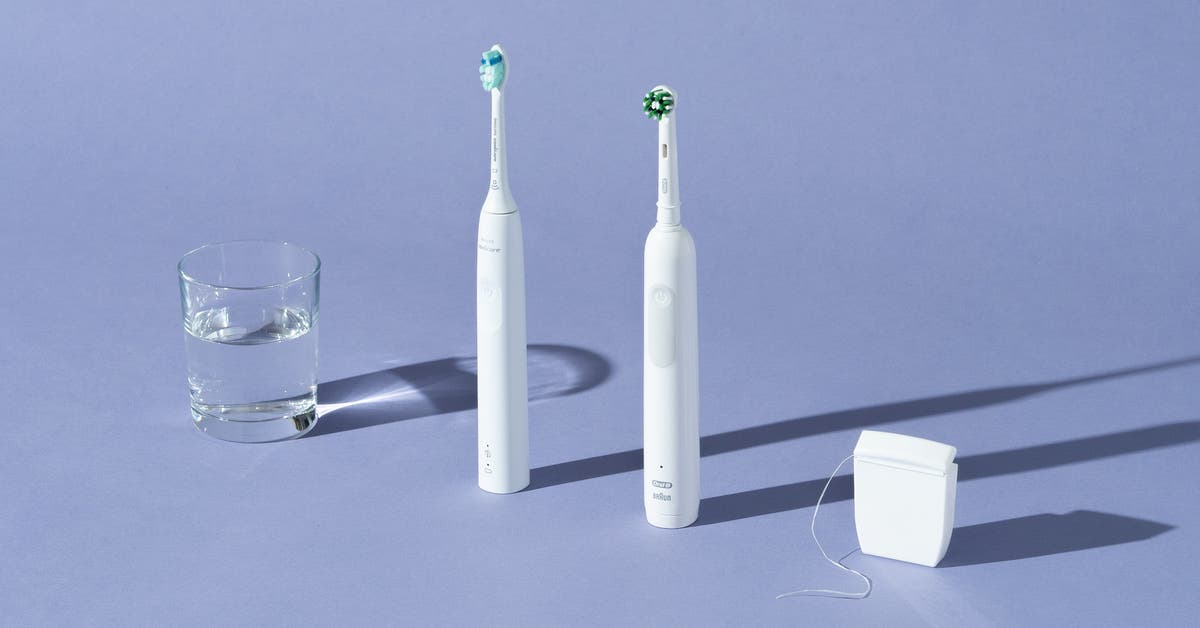
The Philips Sonicare 2100 ($27), 3100, 5100, 5300, 6100, 6500, and 7500 ($200) all feature the same technology as the 4100 and 1100 models we recommend, with a manufacturer-stated 31,000 bristle movements per minute. They differ in available levels of intensity (for instance, the 2100 offers two levels while the 6100 offers three) and the number of cleaning modes (the 1100 and 2100 have only one, while the 6100 has three). The pricier models in this line come with a travel case and other accessories.
Philips Sonicare DiamondClean series brushes have sensors designed to offer brush-head position detection when the brush is synced to the Philips Sonicare app. The Philips Sonicare DiamondClean Smart 9300 has a lighted pressure sensor and a lovely charging cup. In our experience, it has provided nearly the same experience as brushing with the top-of-the-line Philips Sonicare 9900 Prestige — a $400 brush.
Philips Sonicare ExpertClean series brushes pair with the app to collect brushing data in a more perfunctory way, logging each time you brush and for how long, as well as how much pressure you use while brushing. We tested the Philips Sonicare ExpertClean 7500, which is around the same price as the DiamondClean Smart 9300 but performed worse in our tests.
The Philips One by Sonicare is a beautiful, slim toothbrush with a rubber-like material on the back of the brush head, but its “microvibrations” felt much weaker than the vibrations of the Philips Sonicare 4100.
The AquaSonic Vibe is the closest to a lower-priced Philips Sonicare dupe we’ve found. It has so far survived our dunk, drop, and battery tests, plus more than nine months of twice-daily use. Although its replacement heads are less expensive, we found that they require more-frequent replacement in comparison with Philips Sonicare refills. Plus, you need to register the brush to receive one year of warranty coverage.
As with the Philips One by Sonicare, the vibrations of the AquaSonic Icon were weaker than what our pick produced.
The Bitvae D2 has a slightly slimmer body and a slightly thicker brush head than the Philips Sonicare 4100. It’s often on sale for around $20, including two years’ worth of replacement brush heads. But many buyer reviews cite recharging problems after just a few months.
The Burst Original and Burst Pro toothbrushes and replacement brush heads cost more than the Philips Sonicare 4100 and its refills. The Pro version has a pressure sensor, whereas the Original model does not.
The Burst Curve, positioned as a travel-friendly model, vibrates as much in its neck and handle as in its brush head, making for an uncomfortable brushing experience.
Greater Goods’s Sonic Electric Toothbrush (currently unavailable) is inexpensive compared with the Philips Sonicare 4100, and the backs of its brush heads are covered in a rubber-like material, which minimizes the potential for jarring mouth rattling as some testers experienced with our runner-up pick. However, the replacement heads come in only one style and are smaller than average, plus they required more frequent replacement in our testing.
Testers found that the GuruNanda Cruiser’s neck and body vibrated just as much as the brush head, making brushing uncomfortable.
The Laifen Wave’s brush heads felt flimsy and could be difficult to attach firmly. To change the brush’s three settings, within which there are 10 levels each of intensity, speed, and oscillation, you have to use the Laifen app.
We haven’t tested the Mode Electric Toothbrush, which — more than double the cost of our picks — offers wireless charging and an optional night-light.
The Moon Electric Toothbrush is more expensive than our picks. Several owner reviews have alleged charger failure. We found the charger case exceptionally difficult to open.
The rechargeable Quip and Quip Smart toothbrushes are less powerful than our picks. In effect, the Quip brush is a manual toothbrush that vibrates — weakly. With it, you still need to perform brush strokes over the surface of every tooth in order to get a complete clean. In fact, manual “strokes per minute” is one of the Quip app’s performance readouts when paired with a Quip Smart brush. “Sonic bristles help clean,” Quip says, “but you need to put them in the right places by stroking them back and forth in short, tooth-sized strokes on all surfaces of every tooth, one by one.”
Thoughtful design details, including a slimmer brush head, a silky-smooth yet grippy handle, an effective pressure sensor, and the ability to change out only the bristles set the Quip Ultra Smart Sonic apart. It feels more powerful (like it’s doing more of the brushing for you) than previous models from Quip. However, this feature-packed smart brush has a few notable flaws. The haptic sensor, which you control with the slide of a finger on the front of the handle, is easy to inadvertently engage while you’re brushing, changing the strength of the vibrations. And more than once the battery indicators on the brushes we tested failed to warn us when the rechargeable battery was soon to be fully drained. Still, there are several things to appreciate. Unique to this model is a “brush pod” refill ($8 with an active subscription, $12 without) that allows you to change out the bristles without replacing the entire toothbrush head. However, this changeout requires more dexterity than switching out a traditional brush head. The Quip Ultra Smart Sonic syncs to the same app as the Quip Smart brush.
The Suri Sustainable Electric Toothbrush is a gorgeous brush with a mostly metal body, each component of which the company claims is repairable. (By contrast, cracking open an Oral-B or Philips Sonicare toothbrush handle often voids its warranty.) Like our top pick and runner-up, the Suri brush has a two-minute timer with quadrant pacing and a simple, one-button interface. Although the included magnetic wall mount is a nice touch, giving you a place to store a charged-up brush somewhere other than your countertop, in our testing we found that this model’s motor produced weaker vibrations in comparison with the Philips Sonicare 4100, with significant buzzing in the handle. There’s only one type of replacement brush head, available only through the company’s website; Suri accepts spent brush heads for free recycling. The Suri brush is warrantied for one year (a year less than the coverage on our picks), and the company offers a 100-day money-back guarantee. Claims related to device repair and replacement that you make after the warranty expires may involve varying fees.
The Waterpik Sensonic is frequently double the price of the 4100, and its refills cost nearly $10 each. One tester found its bristles and vibration intensity to be especially abrasive.
If you typically use an electric toothbrush and a water flosser, replacing two separate tools with a combination electric toothbrush and water flosser like the Waterpik Sonic-Fusion 2.0 might seem appealing. In practice, however, we’ve found that it’s better to use separate devices. Replacement heads for this Waterpik brush cost over $12 each, making them some of the most expensive we’ve considered.
In general, U-shaped (or mouth-guard-style) brushes like the Y-Brush NylonStart and Autobrush Sonic Pro are much more costly and may be less effective than traditional electric toothbrushes.
Kit Dillon, Casey Johnston, Ellen Lee, Shannon Palus, and Tracy Vence contributed reporting. This article was edited by Tracy Vence and Kalee Thompson.