The Best Handsaw | Reviews by Wirecutter

Top pick
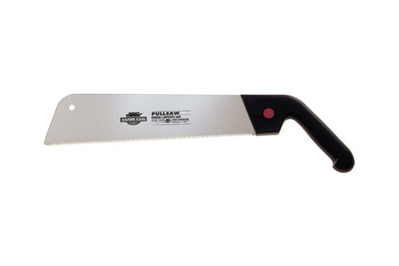
Pro carpenters were blown away by how fast this saw cut. Its pull-stroke cutting style makes it accurate and easier to use than a traditional push-stroke saw.
No other saw in our testing cut quite like the Shark 10-2315 Carpentry Saw 15-Inch. In fact, no other handsaw we’ve ever encountered has cut anything even close to how the Shark 10-2315 cuts. In addition to being the fastest saw we tested, it was also the most precise saw, keeping to a straight, clean cut line better than any of the others.
Its cutting speed stunned everyone. None of the testers, us included, had ever seen a handsaw blow through wood the way this one did. It topped every single timed test we did, making cuts in less than half the time of some of the other saws. When we pulled the Shark 10-2315 on a single stroke through a piece of 0.75-inch-thick pine, it cut a line 1.75 inches deep, almost 30% more than the second-place saw.
Aggressive cutting takes little effort. This saw is designed in the style of a Japanese kataba saw—it’s a single-bladed saw that cuts on the pull stroke rather than on the push stroke as a traditional Western saw does. With a Western saw, you’re basically jamming the blade into the wood in order to cut, which is exhausting and can cause the saw blade to buckle and bend. But with the Shark 10-2315, you’re only drawing the blade back through the wood.
It’s also extremely precise. Once you’ve properly lined up the Shark 10-2315 with a cutline, its tall blade prevents it from wavering at all. “If you’re looking for accuracy, this is the one,” said one of our testers after cutting a perfect 45-degree angle on a 4-inch piece of poplar. It left little shredding on the cut edges of the wood we used in our tests, even on delicate birch veneer plywood.

Because this Shark saw doesn’t undergo an aggressive pushing strain, the width of its blade (the kerf) is thinner than on a Western saw, which further adds to the subtlety and accuracy of its cuts. The blade on a push saw needs to be strong and rigid to work against the tendency to buckle on the cutting stroke. Not so with a pull saw.
It’s versatile. The Shark 10-2315 cuts easily both with the grain (rip-cut) or across the grain (cross-cut). It has 10 teeth per inch, which is a good amount for a general-use saw. The handle is comfortable, and because the blade is removable, you can disassemble the saw for storage. The blade itself is replaceable if damaged.
We used the Shark 10-2315 on the framing portion of a small closet-renovation project, choosing it over a powered saw out of convenience, and the results were fantastic. We saved a lot of time by making the cuts right in the room (something we would never do with a circular saw), and the cuts, even the angled ones, were precise. Using this handsaw took more effort than pushing a circular saw, but it saved us from spending a day going in and out of the house before and after each cut.
Flaws but not dealbreakers
The downsides of the Shark 10-2315 have nothing to do with its performance, but rather its storage. The 10-2315 is a delicate item and needs to be treated with a level of care not usually associated with construction tools—it’s not like a hammer that you can just chuck into the toolbag at the end of the day. The saw comes apart into two pieces, the blade and the handle, which makes it a little more compact, but the blade really deserves to be hung on a nail (it has a hole for this purpose) or otherwise set aside somewhere safe and away from the rough and tumble of a garage or basement workbench.
To protect the teeth, it comes with little plastic blade guards, but they’re tedious to put on and aren’t convenient for use between cuts during a project, so the saw is likely to remain exposed to potential harm if, say, it’s knocked off a workbench.